
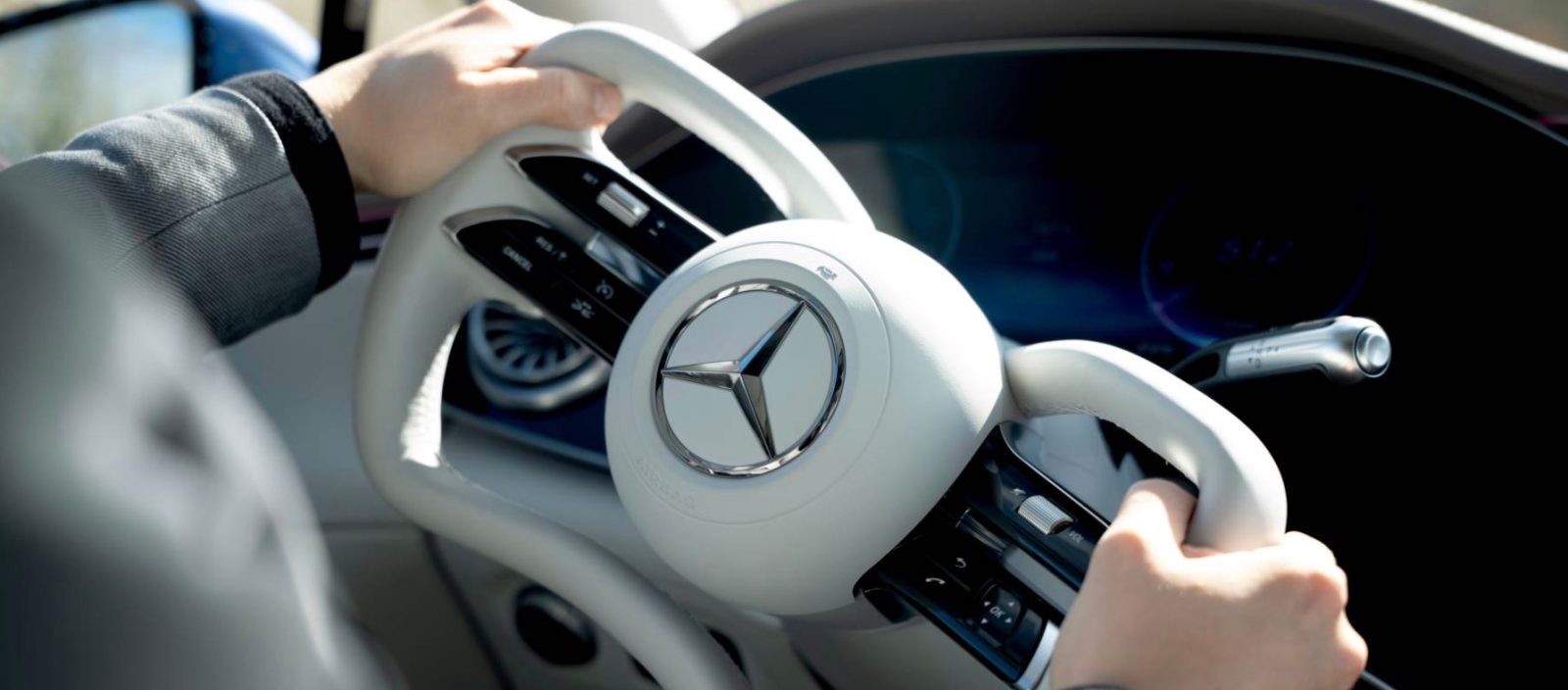
Mercedes-Benz has confirmed it will introduce steer-by-wire technology in 2026, becoming the first German automaker to bring the system to production. The facelifted EQS electric sedan will be the first model to get it.
Along with the new steering system, Mercedes is ditching the traditional round steering wheel for a flat-bottomed yoke design — and it’s a look that will divide opinion.
Steer-by-wire comes to Mercedes
The announcement comes from Mercedes CTO Markus Schäfer, who described the technology as “another big step towards the mobility of tomorrow” that “enables a unique customer experience that goes far beyond steering alone.”

Steer-by-wire eliminates the mechanical connection between the steering wheel and the front wheels entirely. Instead of a steering column, the system uses electronic signals to translate driver inputs into wheel movement. This allows for an adaptive steering ratio that adjusts responsiveness based on driving conditions — quicker at low speeds for easier parking, and more stable at highway speeds.
Mercedes says the system has been validated with over 1 million kilometers of testing on test benches and nearly as much distance on proving grounds and public roads. The setup features redundant architecture with dual signal paths and twice the required actuators, plus a backup power supply. If the primary system fails, rear-axle steering and targeted individual wheel braking can still keep the car controllable.
The technology also works hand-in-hand with the EQS’s existing rear-axle steering, which can rotate up to 10 degrees in either direction. Combined with steer-by-wire, Mercedes claims improved directional stability, lateral agility, and the near-complete elimination of vibrations from rough road surfaces.

The yoke design
Because steer-by-wire eliminates the need for multiple steering wheel revolutions, Mercedes has replaced the round wheel with a yoke. The design maintains the traditional 3 o’clock and 9 o’clock hand positions with four spokes, but features two flattened curves on top and a concave bottom section.
Mercedes argues the yoke frees up knee room, makes it easier to get in and out of the car, and gives drivers an unobstructed view of the gauge cluster display. When combined with the brand’s SAE Level 3 conditionally automated driving system, Schäfer says drivers will be able to “view the display when streaming your favourite show” — a nod to the more relaxed driving position the flat design enables.

The facelifted EQS will be the first model equipped with the system, but Mercedes has confirmed it will roll out to the new S-Class and other future models — including ICE-powered vehicles.
Mercedes joins a small but growing club of automakers offering steer-by-wire. Tesla was first to bring it to mass production with the Cybertruck, while the Lexus RZ 450e offers it as an option. Other vehicles with the technology include the GMC Hummer EV, Rolls-Royce Spectre, and Lotus Eletre.
It’s worth noting that Tesla’s implementation of the yoke in the Model S and Model X — without steer-by-wire — was controversial because it still required multiple turns of the wheel, making low-speed maneuvers awkward. Mercedes is avoiding that mistake entirely by pairing the yoke with steer-by-wire from the start.
Electrek’s Take
We are hyped about steer-by-wire making its way to more vehicles. It was hands down our favorite feature of the Cybertruck — the way it transforms the driving experience is hard to overstate. The steering feels more precise, more responsive, and more connected to what the car is actually doing. And it’s true that once you have steer-by-wire, the shape of the steering wheel matters much less from a functional standpoint. You don’t need to do hand-over-hand turns anymore, so the yoke works perfectly fine.
That said, I’m not entirely sold on the aesthetics of Mercedes’s yoke design. It looks a bit awkward, like elephant ears. It doesn’t have the elegance you’d expect from a brand that prides itself on interior luxury. Tesla’s yoke is polarizing too, but it at least commits to a bold, clean look. Mercedes’s version sits in an odd middle ground.
But let’s be clear: the technology itself is the story here. Steer-by-wire is the future of steering, and the more automakers adopt it, the better. It opens the door to truly variable steering ratios, better packaging, and an entirely different relationship between driver and car. We just wish the first implementation from Mercedes looked a bit sharper while doing it.


FTC: We use income earning auto affiliate links. More.



Comments